
AI-generated content is not good for SEO. It is also not bad for SEO. The category itself is wrong. Google does not rank or demote pages because an AI wrote them; it ranks pages by whether a buyer learns something they could not get from the first five results. That test is what most AI-generated content fails.
The accurate question is not whether AI content hurts SEO. It is whether the content you publish — by any author — passes the information-gain test. This is a cluster support under the AISEO pillar, and the rule we use with PNP clients sits below.
What Google actually says
Google's official position has been consistent since the Helpful Content updates of 2023: the company does not penalize content for being AI-written. It penalizes unhelpful content. Helpful content is content that reflects real expertise, real research, or real first-party data. Unhelpful content is content that summarizes the first five SERP results and republishes the summary as a sixth result.
The wording matters. "Helpful" is doing a lot of work in that sentence. It is closer to "adds information that did not exist on the SERP before this page shipped" than to "answers the keyword."
Why most AI-generated content fails the test
When a marketing team writes the prompt "Write an 1,800-word article about [keyword]," the LLM does what was asked: it produces an 1,800-word article. The article is grammatically clean and well-structured. It also contains no information that did not already exist in the LLM's training data — which is to say, no information the SERP did not already have.

The result is a page that Google can rank reasonably well on the first crawl and progressively demote as it becomes clear there is no information gain. We see this trajectory in client audits constantly. Spike, plateau, decline over six to nine months.
The information-gain test
Before publishing any piece — AI-assisted or not — answer one question: what does this article have that the first five SERP results do not? Acceptable answers include:
- A proprietary number you collected (a benchmark across your customer base, a survey result, an internal product metric).
- A named framework that organizes the topic in a way no one else does (and that you can defend with examples).
- An opinionated take that argues against a SERP consensus, with a defense the reader cannot ignore.
- Real client outcomes, anonymized if needed, that move the conversation past abstract claims.
Unacceptable answers: "It's more thorough." "It uses better keywords." "It has a better hook." None of those create information gain. They create marginal differentiation, which is not enough.
Where AI fits in the workflow (and where it does not)
AI is at its most useful in the middle of an article workflow, not at the ends. Specifically:
- Use AI for research compression — give it 500 keywords from Ahrefs and ask it to cluster by buyer-journey stage. Faster than a strategist with a spreadsheet.
- Use AI for competitor gap analysis — paste the top 10 SERP results for a target keyword and ask what every article missed. Surprisingly good first pass.
- Use AI for sales-call mining — feed it 30 transcripts and ask it to extract the language buyers use to describe a problem. This output is gold.
- Use AI for connective tissue inside a draft you already know what you want to say — section transitions, summarizing a paragraph more tightly, generating alternative headline options.
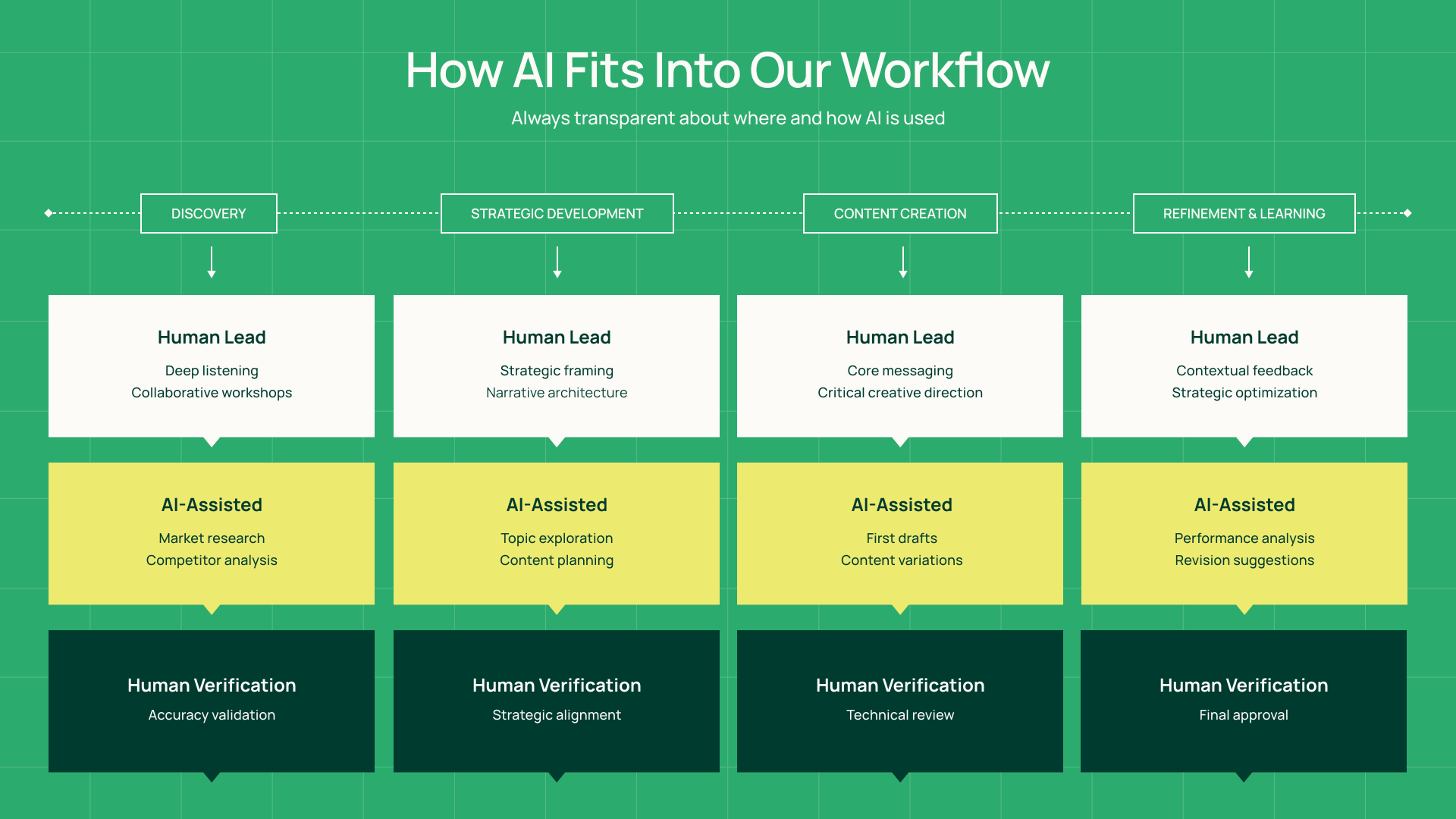
Do not use AI to decide what the article argues. That is the operator's job, not the tool's, and the moment that step gets delegated, the information-gain test fails.
The Papers & Pens Rule
Annie writes most of PNP's content engine output. She has one rule, and we apply it to every piece — AI-assisted or fully human: if a senior practitioner who lives in this category would learn nothing from reading the article, do not ship it. "Senior practitioner" is the person we are trying to convince, and they will not click again next month if the first piece wasted their time.
This rule kills more drafts than the SERP analysis does. It is the rule we recommend to every B2B SaaS content team that asks how to use AI well.
What the audits actually show
The data points that come up most often in PNP client audits, in rough order of frequency. First, AI-assisted content with no proprietary angle ranks for 2-4 months and then declines as Google's quality systems compare it to the SERP baseline. We have watched this trajectory dozens of times. The page does not get penalized in a single update; it gets gradually de-prioritized as helpful-content signals stack against it.
Second, AI-generated content that gets edited by a senior practitioner before publication performs roughly equivalently to fully human-written content. The edit is the load-bearing step. If a senior person reads the draft, kills the weak claims, adds two original observations, and rewrites the opening, the result ranks fine. If the draft goes up after a fluff-pass copy-edit, it does not.
Third, the worst-performing pages in audits are usually the ones that got published with no human review at all. Not because the content was incoherent. LLM output is grammatically clean. Because the content had nothing to say. The buyer reads three sentences and bounces. The bounce signal compounds. Three months later, the page is on page four for its target keyword, and the team is wondering what happened.
The role of editorial guidelines
The teams that use AI well in 2026 share one trait: they have a written editorial guideline that applies regardless of how a draft was produced. The standard usually has three or four bullets — every piece needs a clear position, every claim needs a source, every section needs an information-gain check, and the author of record reads every line before publication. The presence of this standard predicts content performance better than any tool choice.
Editorial standards are unsexy and undervalued. They are also a difference between a team that ships AI-assisted content profitably and a team that ships content landfills. PNP enforces a one-page version of this standard with every client; the document is shorter than this paragraph. Length is not the point. Adherence is.
Where this fits in the AISEO cluster
This piece is one of four cluster supports under the AISEO pillar. The neighbors:
- SEO vs GEO: the precise distinction and why both matter
- SEO vs AEO: where direct-answer optimization fits
- What is Search Generative Experience? A B2B SaaS read
AI-generated content is not the problem. AI-decided content is the problem. The decision is the only part of writing that has not gotten cheaper, and probably the only part that should not.
Frequently asked questions
More Blog to Explore

AISEO Glossary: 50 Definitions Every B2B SaaS Marketer Needs
A complete AISEO glossary for B2B SaaS marketers — 50 essential terms covering AI search optimization, LLM engines, retrieval mechanics, citation measurement, content quality signals, and the optimization tactics that earn citations in ChatGPT, Perplexity, Gemini, and Google AI Overviews.

SEO vs AEO: Where Direct-Answer Optimization Fits
AEO is the discipline of winning the answer panel at the top of a SERP. Where AEO overlaps with SEO, where it doesn't, and how to pick targets.

SEO vs GEO: Where the Two Disciplines Diverge (and Where They Don't)
SEO and GEO share a foundation and diverge at the layer above. The PNP comparison: what each optimizes for, where the disciplines overlap, and the sequence that makes both pay out.